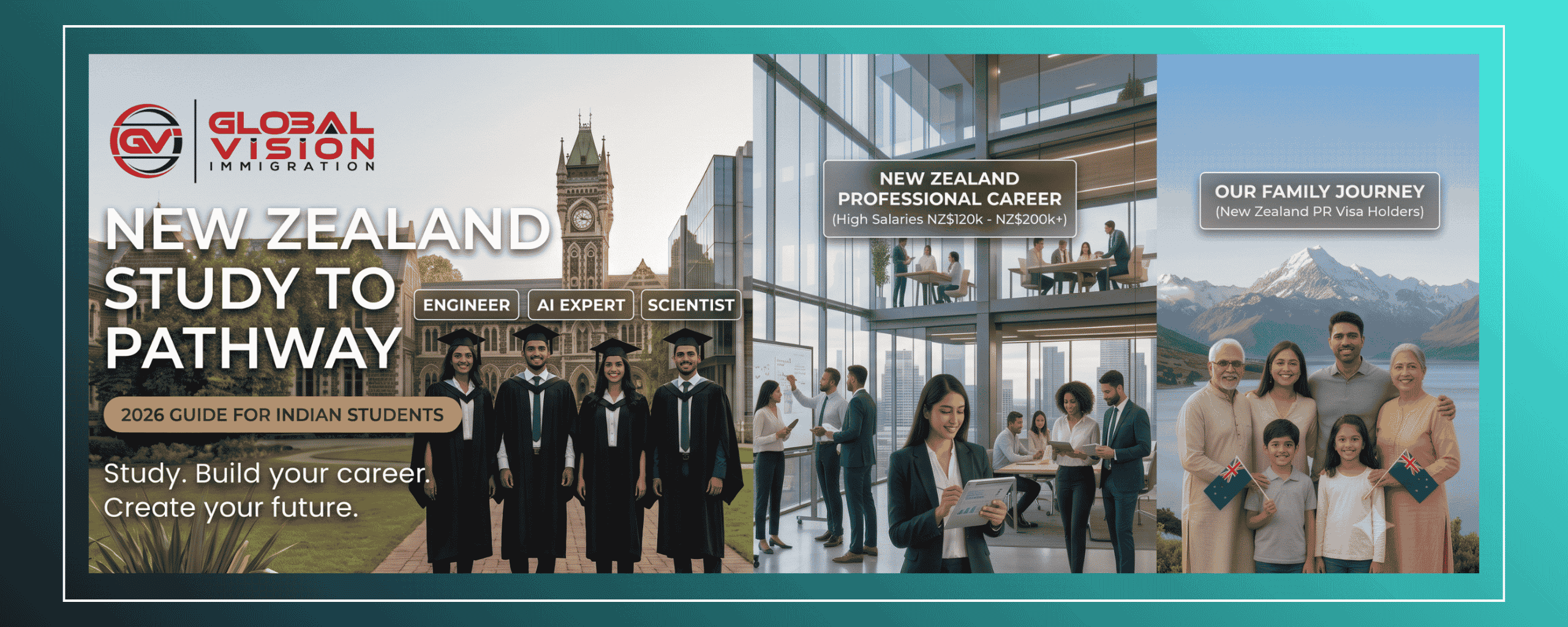
The Easy New Zealand Study To PR Pathway starts with one honest truth: no study choice guarantees residence on its own. So, this guide breaks down exactly what matters at each stage. Whether you are a 12th-pass student, a graduate, or a working professional. Because your course choice, qualification level, and later job offer all shape your route to residence together, not separately. We also cover a major visa update taking effect this November, so you can plan around it now.
New Zealand does not offer direct student-to-residence approval. Instead, separate skilled residence pathways exist, and your study choices simply position you for one of them later.
| Pathway | Who It Suits | Key Terms |
|---|---|---|
| Skilled Migrant Category (SMC) | Workers with occupational registration, a Bachelor’s degree or higher, or 1.5x the median wage | Needs at least 6 skilled residence points, plus current employment or a job offer from an accredited employer |
| Green List Pathway (Tier 1) | Workers with a Tier 1 in-demand job | Residence application opens right away, once wage, qualification, and registration criteria are satisfied |
| Green List Pathway (Tier 2) | Workers with a Tier 2 in-demand job | Requires 24 months of eligible full-time New Zealand work at the required wage, completed before applying |
| Care Workforce and Transport Sector Pathway | Workers in approved care or transport roles | Also requires 24 months of eligible full-time work, paid at the applicable sector or median wage |
So, before choosing a course, work backwards from these four key terms columns. Because they define what actually counts toward the Easy New Zealand Study To PR Pathway, not the course title alone.
A common misunderstanding confuses many applicants early: “PR” in New Zealand is not one single visa. Instead, Immigration New Zealand gives residence in two distinct stages, so knowing the difference now saves confusion later.
Stage one is the Resident Visa. Once you qualify through a skilled pathway, this visa lets you live in the country indefinitely, take up any job, and continue studying, all without restriction. However, it does come with a catch: travel conditions apply for the first 2 years, so re-entry after leaving New Zealand depends on meeting those conditions.
Stage two is the Permanent Resident Visa. After you have held your Resident Visa continuously for at least 2 years, you become eligible to apply for this upgraded status. Crucially, it removes every travel restriction, so you can leave and return whenever you choose, indefinitely.
To reach stage two, Immigration New Zealand requires proof that you are genuinely committed to life in the country. This proof can take a few different forms, so pick whichever fits your circumstances:
Therefore, the complete journey behind the Easy New Zealand Study To PR Pathway runs through five stages: Student Visa → Post Study Work Visa → Work Visa → Resident Visa → Permanent Resident Visa.
Each stage carries its own conditions, so understanding all five now, not just the study stage, is what makes this pathway “easy” to plan.
Courses tied to registered professions, like nursing, engineering, and IT, align best with New Zealand’s residence pathways. This is because registration and Green List occupations both favour structured, recognised qualifications. However, always confirm your specific course leads to a role that appears on Immigration New Zealand’s current Green List.
There is no fixed IELTS bar set directly by Immigration New Zealand for the student visa itself. Instead, your education provider sets the English requirement to confirm your enrolment, and this is typically IELTS 6.0 overall for undergraduate study. So, if your prior education was in English, some providers may offer an alternative pathway or waiver, depending on their own policy.
This depends entirely on your chosen institution and course, not on a fixed Immigration New Zealand rule. Therefore, always check the specific admission criteria for your shortlisted programme.
Each stream connects differently to residence pathways.
So, choose based on the job the course leads to, not the course title alone.
Yes, parents can sponsor both tuition and living costs. However, you must show evidence of at least NZD $20,000 available for living expenses per year of study, on top of tuition proof.
New Zealand’s current minimum wage is NZD $23.50 per hour. So, part-time earnings can help with day-to-day costs, but they should never replace your main proof-of-funds documentation for the visa itself.
Yes, but this depends on your diploma’s level. Non-degree qualifications at Level 4 to 7 must appear on Immigration New Zealand’s official list of qualifications eligible for a Post Study Work Visa. So, always confirm your specific diploma is listed before you enrol.
Both can lead to a Post Study Work Visa, provided the qualification level and course are eligible. However, degree-level study (Level 7 and above) opens broader, unrestricted post-study work rights, compared to some private training establishment diplomas with restricted, field-linked conditions.
Absolutely, yes, once you hold a qualifying work visa, such as an Accredited Employer Work Visa, your partner can apply separately for a Partner of a Worker Work Visa. Eligibility depends on your job’s skill level and wage.
This depends on your career direction and target occupation. So, research which postgraduate qualification connects most directly to a Green List or SMC-eligible role in your field.
A master’s degree offers the strongest post-study work outcome, since Level 7 and above graduates receive up to 3 years of open work rights. A postgraduate diploma may offer a shorter, more restricted visa, depending on its level and field. So, weigh time and cost against the work rights each option unlocks.
A study gap does not automatically disqualify you, but you must explain it clearly and show genuine intent to study. So, a well-documented explanation strengthens your application.
Yes, changing fields is possible. However, immigration officers assess whether your new course logically fits your academic and career background. Therefore, a clear explanation in your statement of purpose matters here too.
A master’s degree, as a Level 7 or higher qualification, qualifies for up to 3 years of open Post Study Work Visa rights. This allows you to work for any employer, in any role, giving you more time to secure a job that fits the Skilled Migrant Category or Green List.
No. Most postgraduate courses do not require prior work experience for the student visa itself, though some competitive programmes may prefer it.
Occupations on the Green List, such as many roles in healthcare, engineering, and ICT, connect most directly to a fast residence pathway. So, checking the current Green List before you finalise your course is a smart, verifiable step.
You must apply no later than 3 months after your student visa’s end date. Doctoral graduates receive a longer window of 6 months. So, plan your application timeline carefully around your course completion date.
Yes, your existing experience can guide you toward a postgraduate course that builds directly on your profession, rather than starting over. This often strengthens your eventual Skilled Migrant Category application too.
This depends on your current occupation and qualifications. If you already hold a Bachelor’s degree, occupational registration, or a high income, you may qualify for the Skilled Migrant Category without further study. However, if your field needs updated skills or registration, studying first may open stronger options.
Choose a postgraduate diploma or master’s that builds on your existing profession, rather than an unrelated foundation-level course. So, this keeps your profile consistent for both your visa and future employers.
A gap alone does not automatically create a problem. However, you should be ready to explain it clearly, alongside your genuine reason for returning to study.
Yes, this is possible, subject to standard visa terms for each family member.
This depends on your own qualification level. Partners of students receive an open work visa if you are studying for a master’s or doctoral degree, or a Level 7 or 8 qualification on the Green List or the Post Study Work Visa eligible list.
From March 9, 2026, New Zealand’s median wage is NZD $35.00 per hour. This figure matters for several categories:
| Threshold | Requirement (from March 9, 2026) |
|---|---|
| Skilled Migrant Category (income-based route) | 1.5x median wage, or NZD $52.50 per hour |
| Green List salary thresholds | Tied to the NZD $35.00 median wage |
| Partner support (Skill Level 1-3 job) | NZD $28.00 per hour |
| Partner support (Skill Level 4-5 job) | NZD $52.50 per hour |
Once you secure a qualifying job offer from an accredited employer, you can apply for an Accredited Employer Work Visa (AEWV). This visa requires 2 years of relevant work experience or a Level 4 or higher qualification, alongside your job offer.
Yes, this is the core final step. If your job sits on the Green List Tier 1, you may qualify for the Straight to Residence Visa directly. If it does not, the Skilled Migrant Category remains open, based on your registration, qualification, or income level.
Immigration New Zealand is introducing real changes that affect this pathway, starting November 16, 2026.
So, if your course or diploma earlier did not match the post-study work eligibility, this update may change that. Always confirm current eligibility directly on the official Immigration New Zealand website before you plan around it.
| Qualification Level | Post Study Work Visa Duration |
|---|---|
| Level 7 degree and above (Bachelor’s, Master’s, PhD) | Up to 3 years, open work rights |
| Level 4-7 non-degree (on the eligible list) | Matches study duration; work restricted to your field |
| Level 7 Graduate Diploma + existing Bachelor’s (from Nov 16, 2026) | Up to 1 year |
| Level 5-7, not otherwise eligible (Short-Term Graduate Work Visa, from Nov 16, 2026) | Up to 6 months, open work rights |
The Easy New Zealand Study To PR Pathway only stays easy when your course, qualification level, and career goal line up correctly. So, getting this right the first time saves years, not just money.
GVI’s dedicated New Zealand Study Visa team reviews your full profile against New Zealand’s current pathways, step by step. Contact Us today or start with a Free Assessment to plan your New Zealand journey correctly.
Mr. Kalyan Paul, President & CEO is the founder of GVI, an MBA in Finance, and also a Chartered Professional Accountant (CPA) and a Certified Management Accountant (CMA) from Canada. Mr. Paul has more than 22 years of experience in immigration consulting that made him one of the preferred & valued immigration consultants in the immigration industry. He is a licensed member of the College of Immigration and Citizenship Consultants (CICC) [Previously known as Immigration Consultants Of Canada Regulatory Council (ICCRC)] (Membership ID: R417119) which is a professional body of licensed immigration consultants recognized by Citizenship and Immigration Canada.
Read MoreThe maple leaf country is making waves for the best reason ever. As Canada Named World's Safest Country In 2027...Read More
Oct 28, 2026, brings the most unexpected news for Canada immigration. Just when everyone is focusing on PNP, French, CEC...Read More
Breaking News: Canada has decided to focus strongly on Francophones. Because we see Canada Again Maintains 5000 ITAs for French...Read More

Choose your preferred time and share your questions. You will be speaking with a team that is trained by a CICC-licensed Immigration Consultant, ensuring you get reliable and accurate guidance.
 Canada


 New Delhi, India


 Siliguri, India